Flying wing
My Matura project, which included a programmed flight computer, various sensors and aerodynamic design.
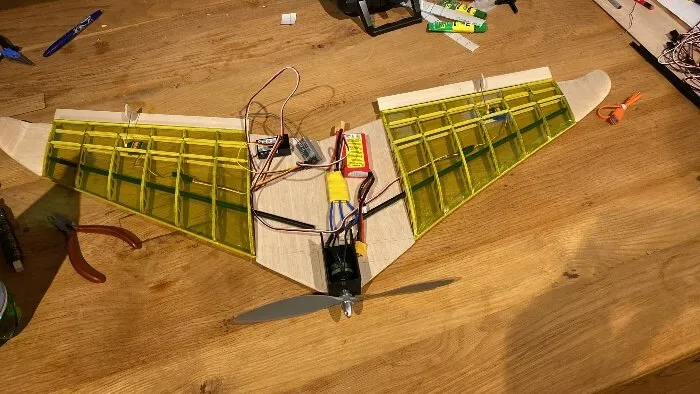
For my Matura I designed and built a flying wing: 95 cm of balsa, no tail, and everything a tail normally does folded into the wing.
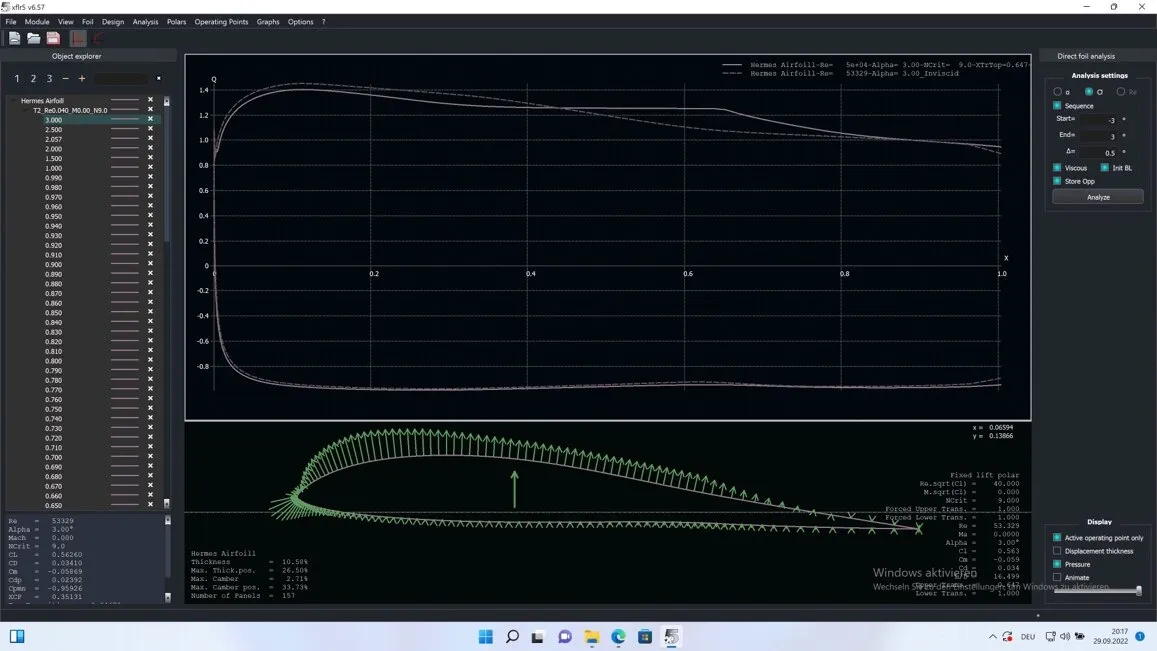
I started with the airfoil and drew my own in XFLR5, then analysed it against the MH60 profile the industry uses. Mine lost. The curves never crossed, so my reflex produced no downforce at the trailing edge, and I took the MH60. The wing got 35 degrees of sweep, five degrees of dihedral, and its size fell out of a Reynolds number: with a 95 cm span and a mean chord of 18.3 cm, the profile works from about 11 m/s.
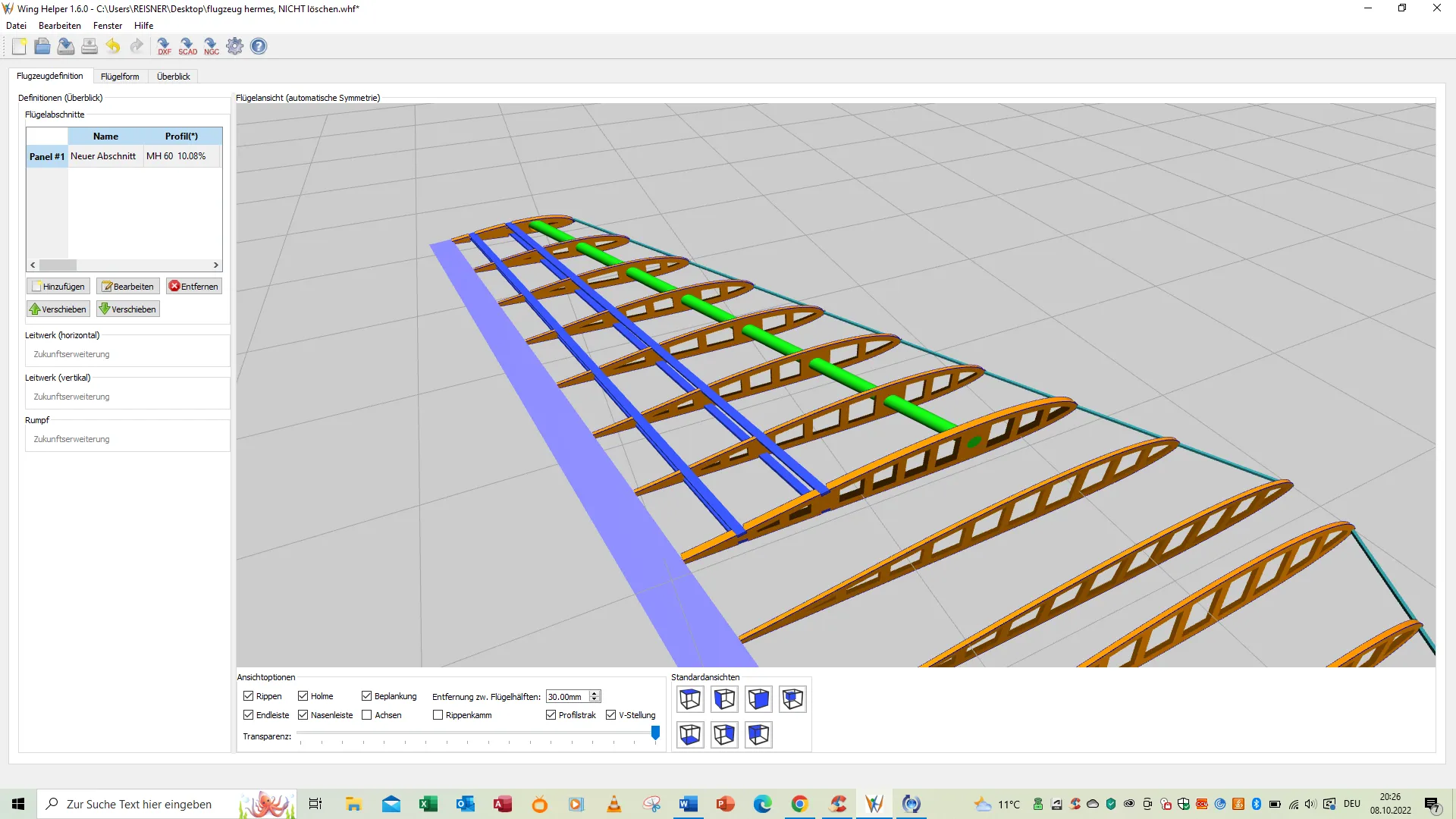
Fusion 360 gave me a model I could not build, because what I had drawn was an aluminium construction. Wing Helper turned the same wing into a plan for wood, which I exported as DXF and cut from balsa on a laser cutter: ten ribs with lightening holes, a round spar, elevons 15 mm wide.
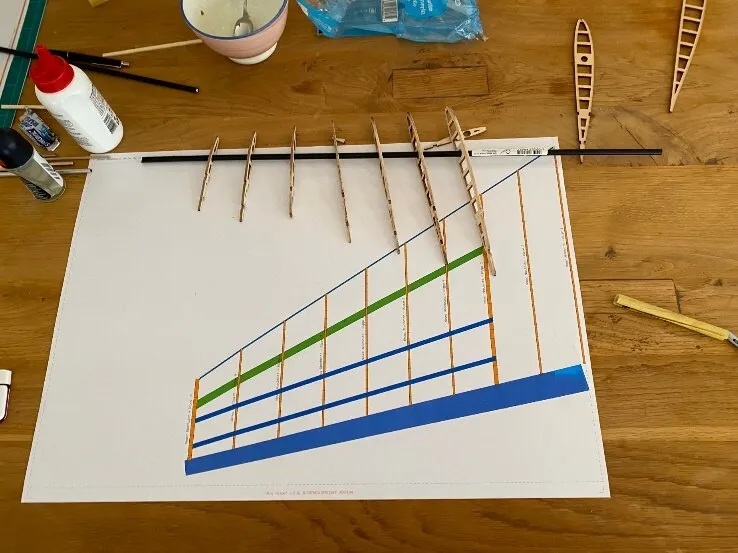
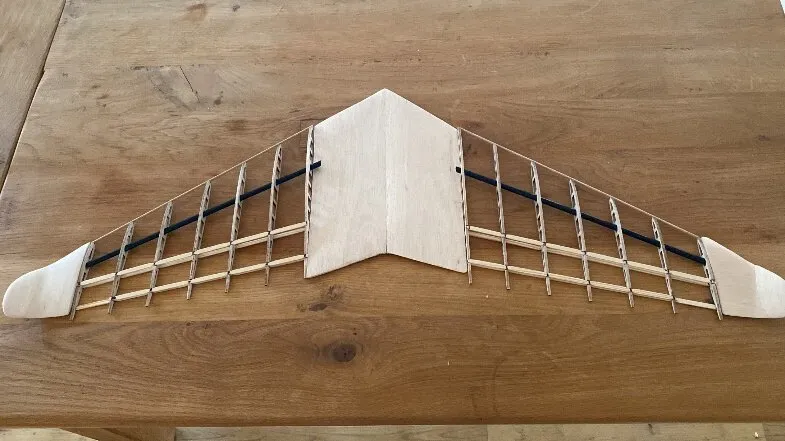
The bare frame weighed 360 grams. Finished, with motor, servos, receiver, gyro and the battery on velcro so I could still move the centre of gravity, it came to about 850.
Somewhere in the middle of that I connected the battery the wrong way round and set it, and the receiver, on fire. I sanded a new base plate, made it sturdier, and learned what a diode is for.
It flew. Thrown by hand it glided, the centre of gravity sat too far forward, and I trimmed the reflex. On the first powered flight the left elevon came off, two seconds after launch. One side with reflex and one side without is an aileron input nobody asked for: it rolled, went inverted and came down. The right wing did not survive, and neither did the deadline.
The wing was never the problem. The balsa elevons and the way I attached them to it were. Next time: propeller at the back, a printed centre section, elevons in carbon, and a smaller aircraft.
I still work in that loop. Read until the theory holds, draw it, simulate it, build it, watch it break, then find the exact part that broke instead of blaming the aircraft. XFLR5 and Wing Helper, the laser cutter, the DXF files and the soldering iron all started here — and so did the habit of putting my own result next to the standard one and saying out loud which of them is better.